
Crisis Intervention Team Training: A Calm Voice in a Crisis
Wytheville Police Laud Mount Rogers Community Services Training
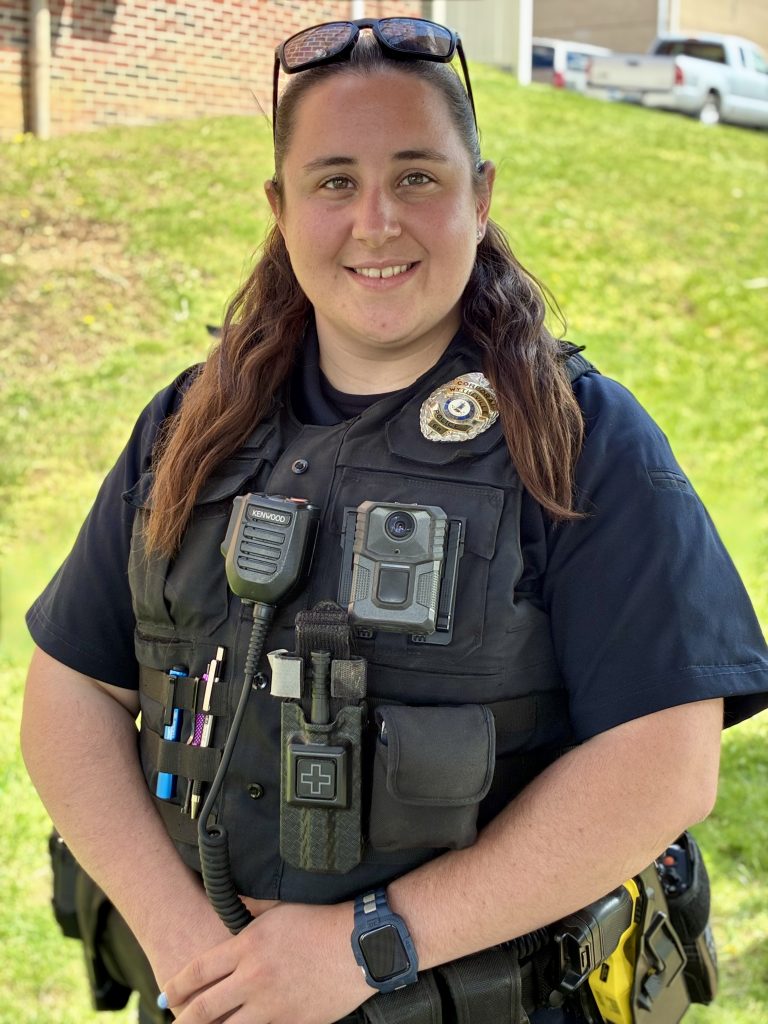
Cpl. Brandi Holmes of the Wytheville Police Department was unsure of what she would find when she pulled up to the apartment complex where a man was in mental distress with a weapon.
The man’s mother had reported him missing earlier, and she told police he had been screaming at her over the phone. Now, on the chilly first day of spring, the man was back in his apartment. He had a machete.
Holmes eased into the man’s apartment as the second officer on the scene. “We’re just here to talk,” she said, as her training and experience kicked in.
She always wanted to be in law enforcement, starting in the 911 dispatch center before transferring over to patrol about 3 ½ years ago. Being a dispatcher came naturally to Holmes, and it turned out to be good training for patrol.
“I like to talk to people,” Holmes said. “You get farther with words than other things.”
CIT Training
She was good at making conversations. She has also had 40 hours of Crisis Intervention Team (CIT) training offered by Mount Rogers Community Services.
The primary goal of CIT training is to enhance the skills and knowledge that officers learn in the academy to safely and effectively respond to individuals in crisis, said Mount Rogers Director of Crisis Management Services Kim Woodlee. In situations such as this, CIT training helps officers have a better understanding of underlying mental health issues that may contribute to the issue at hand. It also gives them an extra tool that allows them to proceed in a manner that is as least restrictive as possible while maintaining safety.
Cpl. Holmes recognized the man, whose muddy, wet jeans, shirt, and socks told the story of a man who had spent a night or more out in the woods. He had also left a note with detailed instructions for the care of his dog.
One time she worked on a case involving his moped that someone stole from him. Holmes tracked the moped to Tennessee and recalled telling the man where to find it.
But she also had worked with him when she was 17, and he was in his 30s at a Burger King just down I-81. Despite the previous interactions, she could see he didn’t recognize her when she stepped into his apartment.
Taking the Right Approach
Holmes approached with a smile and spoke to him by his name. “I do it with a mellow voice,” she said. “They do teach that in CIT.”
The man told them repeatedly that he couldn’t trust anyone. He couldn’t believe them. He also said he had the machete in case he needed to defend himself. It was his right, he said.
Not long after she entered the room, the man told the other officer he only wanted to talk to Holmes. She kept the conversation to things she thought might calm him down.
The man had a beautiful Husky named Jupiter, Holmes said. She knew the man had a deep connection to Jupiter, who he took great care of and had left ample food and water for as he was out in the woods.
She relied on her CIT training – starting with getting the person’s name and finding out what’s wrong and repeating it back to them. Stay locked in and keep eye contact. And Holmes worked to make a connection. “We know that the relationships that we as counselors and law enforcement are able to develop with individuals can very often determine the outcome of that situation, and we stress that in CIT training,” Woodlee said. “Folks in crisis often just want to feel heard and the interactions that they have with law enforcement may be their only opportunity for that to happen.”
Watching for Signs in CIT Training
There were points in the 28 minutes she was in the apartment where Holmes could see the white of his knuckles from when he was gripping the machete so tightly as he sat on his couch. She gently moved closer to within about four feet – “Which is a little close,” Holmes said – and kept him talking.
“Anything I could think of that might mellow him out,” she said.
She watched his body language as a window into his mental health. He didn’t appear to be threatening, but he wanted to keep distance between them, Holmes said.
“There were multiple points that I didn’t know if it was going to work,” Holmes said. In situations like this, “You just take deep breaths and hope to God what you say doesn’t set them off.”
At one point he mentioned he believed it was his time to die. “I don’t think so,” Holmes said. “You’re here for a reason. You have people who care about you.”
Being in Control
Eventually Holmes was able to get him to drop the machete. She knew he used chewing tobacco, and she told him if he came with her, she’d let him keep her snuff. “I’ll even let you take a pinch,” she said.
Even as he submitted to Holmes searching him, she wanted him to feel like he was in control. She would ask his permission at each step of the search and when she put him in handcuffs. She also kept talking and asking how he was doing, even as she handcuffed him.
“He’s like, ‘I’m ok,’” Holmes said.
She told him they would go to the hospital. He was fine with that.
“I’m glad it ended the way it did,” Holmes said. “They have to know they can trust what you’re saying.”
CIT Training: `Words Over Force’
Wytheville Deputy Chief of Police Bryan Bard said the resolution of the incident is exactly why the Wytheville Police Department has made CIT training a cornerstone of the agency.
“Since we first began our partnership with Mount Rogers Community Services back in 2007 when CIT was introduced in Southwest Virginia, our goal has been to provide our officers with the tools to navigate the complex intersection of public safety and mental health.
In Wytheville, CIT isn’t just an optional seminar; we require all our law enforcement staff to be certified CIT Officers, taking a full 40-hour course to become certified, and an additional 40 hours for some of our officers to become CIT Instructors. Cpl. Holmes’ 28 minutes in that apartment—her focus on eye contact, active listening, and de-escalation—highlights the success of that 19-year commitment. By prioritizing words over force, she protected the subject, her fellow officers, and our community. This outcome is the direct result of a departmental philosophy that views empathy as one of the most powerful tools on an officer’s belt.”
Making a `Lifeline’
Wytheville Chief of Police Joel Hash said Cpl. Holmes “exemplified the very best of the Wytheville Police Department during this recent encounter. Facing a situation that was fraught with tension and the presence of a weapon, she relied on her professionalism and her compassion to reach a peaceful resolution. What could have easily escalated into a tragic use of force incident was instead transformed into a lifeline for a citizen in need.
Brandi’s ability to remain calm, maintain a ‘mellow voice,’ and build a genuine human connection is a testament to her character and the efficacy of the CIT model. She didn’t just clear a call; she saved a life and ensured an individual received medical treatment rather than a jail cell. We are incredibly proud to have her representing this agency on the front lines.”
About Mount Rogers Community Services — Mount Rogers is a top provider of community services for behavioral and mental health, intellectual and developmental disabilities, and substance use disorders in southwest Virginia. We also offer geriatric, counseling, early intervention, and other services in Galax and the counties of Bland, Carroll, Grayson, Smyth, and Wythe.